
Accounting for a Sale under US GAAP (Seller-Side Guide for Startup Finance Leaders)

Kyle Geers
September 4, 2024
Most finance leaders are familiar with the buy-side of M&A, but what happens when your company is the one selling? The accounting for a sale or spin-off under US GAAP is significantly different from a buyer-side acquisition, and getting it wrong can delay your deal or create audit issues.
This article walks you through the seller-side accounting for a sale or spin-off of a business or asset group—written for finance leaders at growth-stage startups who need to get it right and fast.
Watch our video walkthrough on available for sale accounting:
TL;DR: Accounting for the Sale of a Business under US GAAP
- Decide whether you’re selling a business or assets — this drives your accounting treatment.
- Measure total consideration received (cash, notes, equity, earnouts).
- Identify and remove the assets and liabilities sold (the “carve-out”).
- Calculate the gain or loss on the sale, and assess discontinued operations or held-for-sale presentation.
- Prepare disclosures and audit-ready documentation that align with ASC 810 and ASC 205-20.
What is a Sale or Spinoff of a Business?
As a business grows, it often expands into new areas of business beyond where it had initially started.
For example, consider Company ABC that sells equipment specifically for local restaurants in Southern California. As Company ABC continues to grow, it may decide to begin selling in:
- New locations (i.e. states, domestic regions, or international),
- Additional product lines (such as equipment for breweries), or
- Other customer profiles (i.e. larger restaurant companies and chains).
As a company grows, it may notice that certain parts of its business don’t perform as well as others. It may take far more time and effort to create and sell certain products, or fewer customers/sales are interested in a certain product. These lower-performing parts of the business result in lower, or even negative profits, and can drag on the overall success of the business.
When this happens, Company ABC’s management may make the decision that it needs to cut ties with these underperforming units, so it can focus on where it is most successful. To do this, they decide to sell, or “spin off” those underperforming parts. Examples of this could be an unsuccessful product line, an underperforming location/geography, or an entire business/entity.
Oftentimes, there are other parties that are interested in buying these same parts because they can be far more successful with them. This often includes strategic buyers, such as another business that sees synergies with their existing business, or financial buyers, such as private equity firms with a strategy to improve the financial results and later sell for a profit.
Scoping the Sale: Which US GAAP Guidance Applies?
As per usual, accounting for a transaction can be very complex under US GAAP, and this type of transaction is no different. There are multiple topics of US GAAP that the accounting can fall under based on the facts and circumstances of the deal, with different accounting treatment for different topics.
Finding the right accounting framework for the sale or spinoff is shown in the following flowchart from US GAAP guidance:
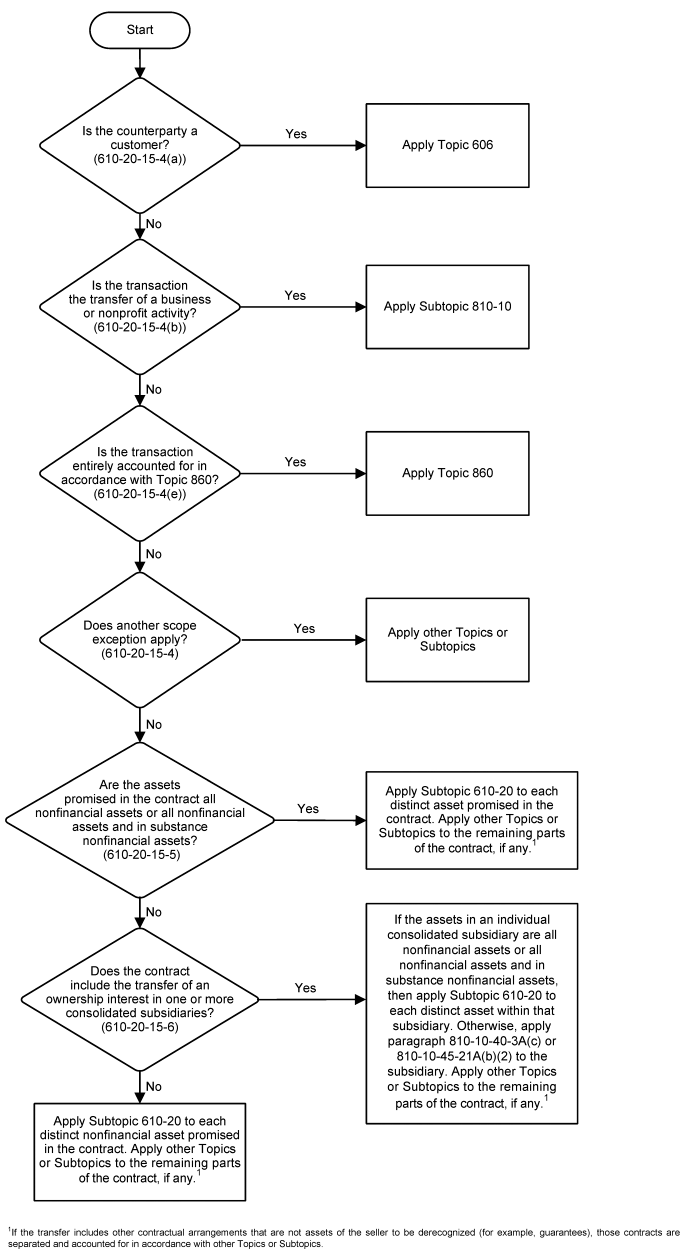
As a summary, the evaluation goes as follows:
- Is the Buyer considered a customer of the Company? If so, then this should likely be considered as a revenue contract with a customer, under revenue guidance of ASC 606.
- Is the sale considered a transfer of a business (or nonprofit activity)? If the assets/units being sold meet the definition of a “business” under US GAAP, then the accounting will be treated as derecognizing a consolidated subsidiary under ASC 810-10. See our other blog articles that provide more detail on what is considered a business under US GAAP.
- Does the sale fall under other miscellaneous topics or scope exceptions? This includes Topic 860 (Transfers and Servicing) and other scope exceptions noted in the guidance. They are less common, and so we won’t go into detail here, but important to consider in the evaluation.
- Does the sale include all financial assets, nonfinancial assets, or both? Financial assets include assets like cash, receivables, investments, etc.; most other assets are considered nonfinancial assets.
Depending on how these questions are answered in the ASC flowchart, you’ll find the related guidance for the transaction.
How to Account for the Sale of a Business (Step-by-Step)
For this article, let’s assume that the sale isn’t a revenue contract (under ASC 606) and doesn’t meet the miscellaneous topics or scope exceptions noted above. For the remaining options, accounting treatment tends to be most common and relatively similar between the related topics.
Step #1: Determine Consideration Received
First, you need to find out what your company is receiving from the sale. This could be cash, deferred payments, a loan/note from the Buyer, equity shares/warrants, or an earnout. Identify each item and its fair value on the sale date.
Step #2: Determine Assets/Liabilities Being Sold
Next, identify what items and amounts on your company’s balance sheet will be removed because of the sale. This could be an entire entity’s balance sheet, selected accounts, or even a portion of certain accounts. The exercise to separate the sold parts of the business from the remaining company is commonly called a “carve-out.”
Step #3: Calculate the Gain/Loss on the Sale
Finally, calculate the amounts being received and sold from Steps 1 and 2, and the difference between the two will be considered as either a gain or a loss on the sale.
Additional Accounting Considerations
As with most other US GAAP topics, you guessed it, there are more factors to consider that can add complexity to the accounting:
Discontinued Operations
In addition to accounting for the sale, you also need to evaluate if the parts of the business being sold meet the definition of “discontinued operations” under US GAAP. If so, then this requires a specific presentation of the sold parts of the business, including its operations prior to the sale, and significant disclosure requirements.
Read more: How to determine if your sale qualifies as discontinued operations.
Held-For-Sale Classification
For parts of the business that are not yet sold, but being actively marketed as of a reporting date, those assets/liabilities may meet certain “held-for-sale” classification under US GAAP, which requires a different accounting treatment from assets and liabilities in normal operations.
Related Agreements and Allocations
Consider if there are related agreements as part of the sale that may need to be considered. For example, including a Transition Services Agreement at a cost that is at $0 or below fair value amounts for services provided, could result in allocating some of the sale price to that agreement.
Key Disclosures
Expect auditors to request:
- A description of the sale and timing
- The major classes of assets and liabilities sold
- Total consideration received and the components thereof
- Pre-tax gain or loss recognized
- Details of any continuing involvement or TSAs
If you’re a startup preparing for diligence or audit, be proactive—these disclosures are often the biggest time sink late in the process.
Ready to Get It Right the First Time?
Selling a business is one of those moments that will test your accounting team’s processes, documentation, and judgment.
If you’re not 100% sure which GAAP framework applies, or how to prepare the memo that auditors expect, start here:
Book a Free Consultation with a Technical Accounting Expert
Get clarity on your specific transaction and receive a recommended memo outline.
Schedule a Free Consultation
Related Articles
GAAP Compliance Mistakes: The $10M Loan That Nearly Fell Apart
A real-world case study of how cash basis reporting nearly derailed a $10M+ loan — and how to avoid the GAAP gaps that block fundraising.
Kyle GeersLease Accounting Under ASC 842: Why Excel Isn't Always Enough
When to use Excel vs. dedicated software for ASC 842 lease accounting — a practical guide for late-stage startup finance teams preparing for audits.
Kyle GeersHeld for Sale Accounting under US GAAP
Walk through the US GAAP evaluation model for held-for-sale classification, including the six criteria that must be met and the resulting accounting treatment.
Kyle Geers