
How to Govern AI on Your Accounting Team

John Ikosipentarhos
November 19, 2026
Most accounting teams start using AI before they decide how to use it. Someone tries ChatGPT on a reconciliation, it works, and a month later half the team is using three different tools with no rules about what goes in or who checks what comes out.
The gap is in governance, and in accounting it shows up in the financial statements.
Fixing it takes a short list of decisions made before rollout. You don't need a 40-page policy. Below is the framework we use in our own firm, where AI touches reconciliations, journal entries, and technical memos every month.
One note before we start. We're accountants, not AI governance specialists. AI keeps changing, and so does the way we govern it. What follows is what works for our team today, and we're sharing it in case it helps yours.
Why Accounting Needs Stricter AI Rules
In most departments, a bad AI answer costs some time. In accounting, it ends up in a number someone else relies on. Your auditor, your lender, your board, and your investors all read what your team produces.
AI also fails in a way that's hard to catch. A staff accountant's mistakes usually look like mistakes. AI output looks finished. The formatting is clean and the citations sit in the right places, even when they cite the wrong paragraph.
And errors compound. A mistake early in a workflow carries into every step built on it, so one bad input at the top becomes a bad conclusion at the bottom.
Practical example
Technical Accounting Memos
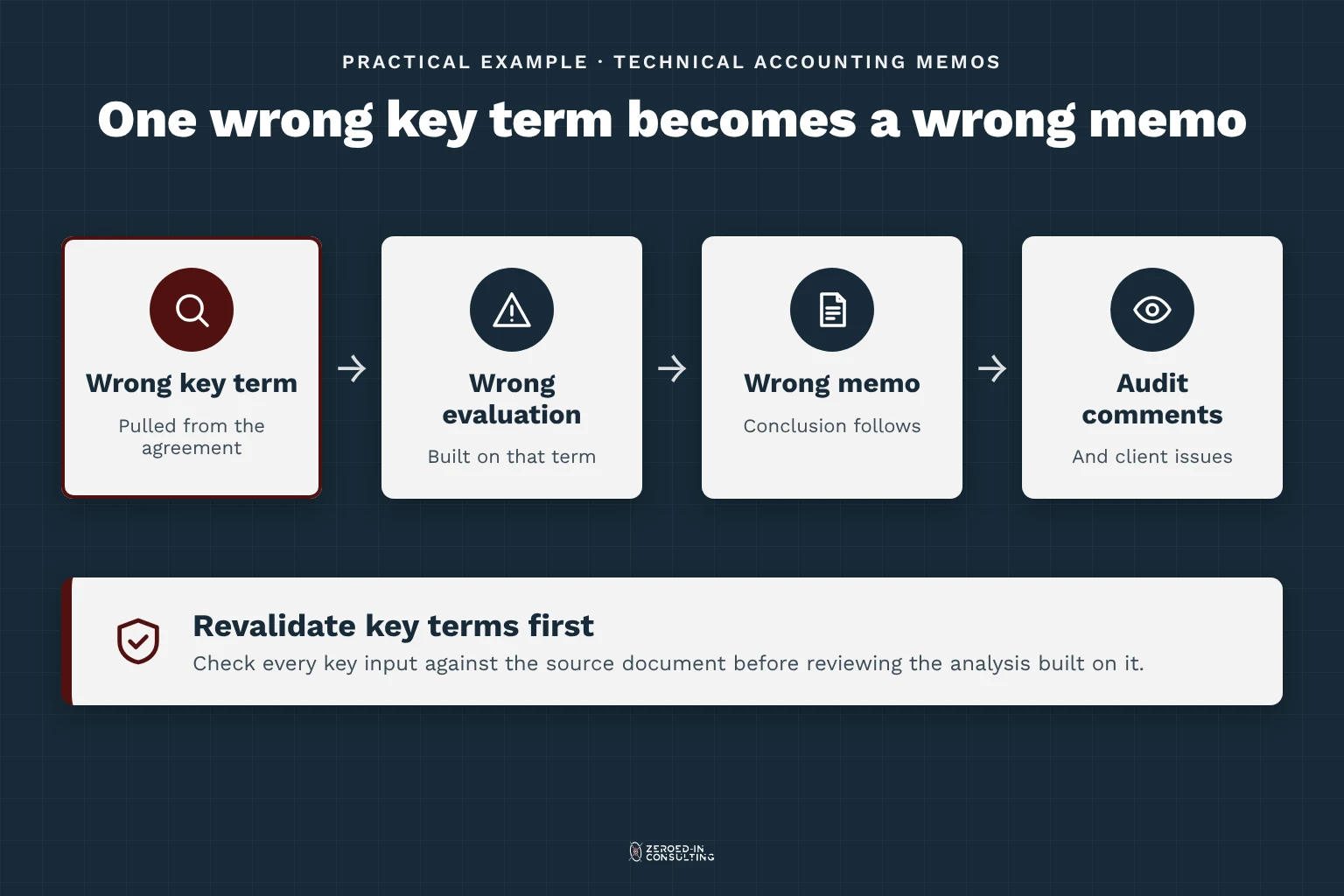
Our memos on debt, equity, and acquisitions start with key terms pulled from an agreement. If AI pulls the wrong term, the accounting evaluation built on it is wrong. If the evaluation is wrong, so is the memo. Then the auditor comments, and the client has a problem.
That's why our reviewers revalidate the key terms against the source documents before they review anything else.
The Six Parts of AI Governance
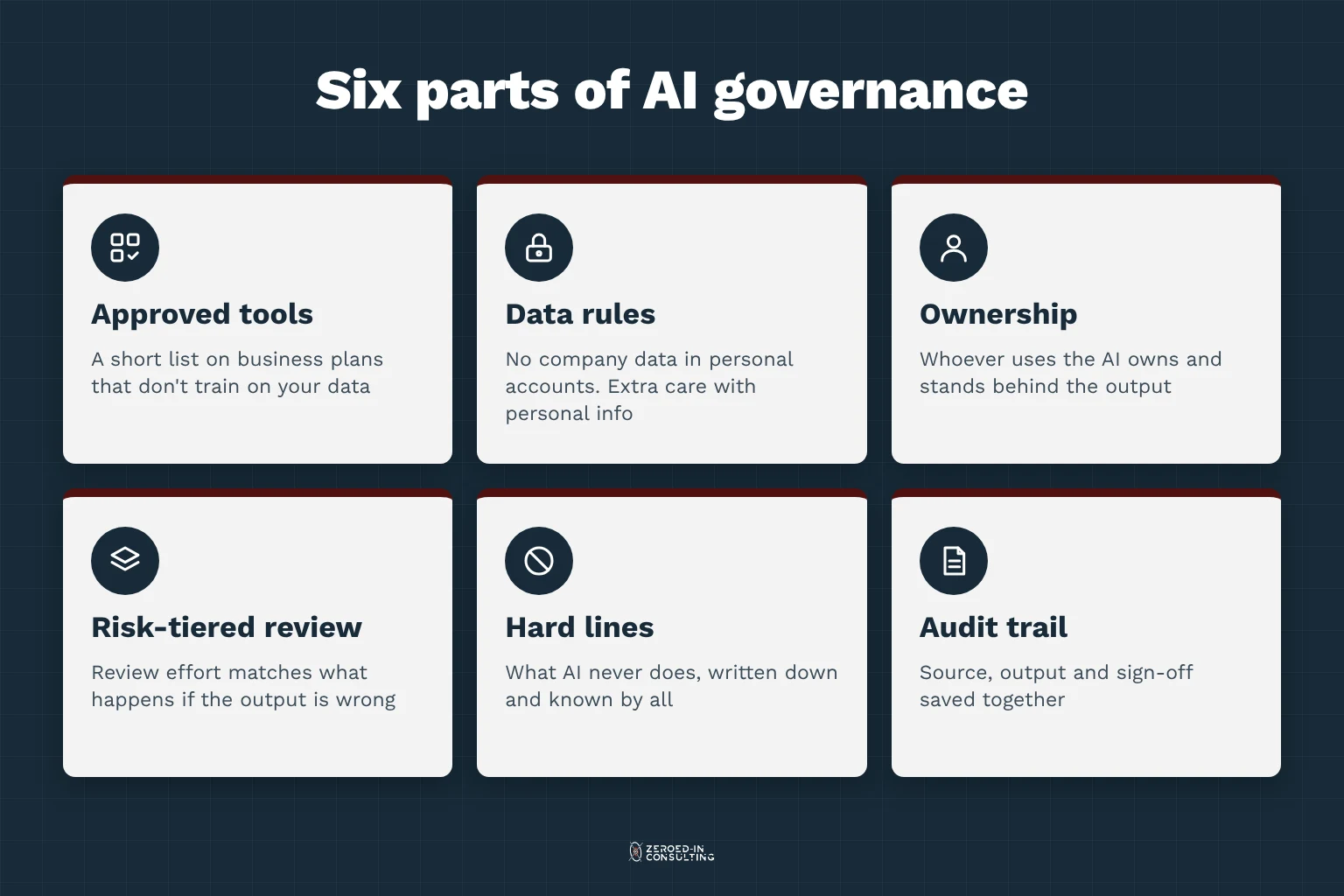
Every AI governance framework we've built for an accounting team comes down to six decisions. You can make most of them in a single meeting.
1. Approved Tools
Name the tools your team may use, and keep the list short. Ours is Claude, ChatGPT, Ramp, and ClickUp. Every approved tool runs on a business plan that doesn't train on our data, with accounts the firm controls.
A short list does two things. It keeps company data in tools you've vetted, and it means your team gets good at a few tools instead of dabbling in a dozen. When someone wants to add one, ask what it can access, where the data goes, and whether it fits how you already work.
2. Data Rules
Decide what data can go into which tool. One rule covers most of the risk. Company data never goes into a personal account. After that, be stricter with employee and customer personal information than with general ledger detail. Payroll registers and customer lists deserve more care than a trial balance.
3. Ownership
Whoever uses the AI owns the output. That's our rule. If you ran it, you review it, and you're the one who stands behind it. The AI doesn't sign off, and "the AI said so" isn't support.
Put that in writing. Accountability sits with the person who generated the output, so it doesn't get passed up to the senior reviewer. The reviewer is a second check on work the preparer already stands behind.
4. Risk-Tiered Review
Not every AI task needs the same review. A formula fix doesn't need a second set of eyes. A technical memo does. Tier your workflows by what happens if the output is wrong, and set the review to match.
| Tier | Examples | Review | Signs off |
|---|---|---|---|
| Low | Formula help, cleaning up a workbook, summarizing your own notes | Preparer checks the output | Preparer |
| Medium | Bank and card recs, transaction coding, recurring journal entries | Preparer ties the output to source documents before anything posts | Preparer, with normal close review |
| High | Technical memos, non-routine entries, key contract terms, anything that leaves the building | Preparer revalidates the key inputs, then a second reviewer checks the work | Preparer and a second reviewer |
| Off limits | Final judgment calls, and sending anything to customers, auditors or lenders | A person makes the call. AI can help draft a message, but a person sends it | Not delegated to AI |
Journal entries are a good example of why tiers matter. We let AI recommend entries. For low-risk recurring entries, the review is lighter. For high-risk or non-routine entries, someone reviews before anything posts, every time.
5. Hard Lines
Some things AI doesn't do, no matter how good the output looks. Write these down. Here are ours.
- AI never sends anything to a client. It can help draft. A person reviews and sends every message.
- AI never makes the final judgment call. An accountant works through the analysis with the AI and lands on a conclusion they agree with and stand behind.
- Nothing high-risk posts without review. AI can recommend the entry. A person approves it.
What our clients pay for is our judgment and the people behind it. A tool sending emails in our name would take that away, so we keep a person between AI and every client conversation. For an in-house team, the same rule applies to your auditors, lenders, and customers.
6. Audit Trail
For anything that touches the financial statements, keep the source, the AI output, and the reviewer's sign-off together. If a control depends on AI output, document how the output gets reviewed, the same way you'd document any other control. If you're heading toward an IPO or SOX compliance, your auditors will expect this.
How We Govern AI in Our Own Firm
Here's what review looks like for a client deliverable at Zeroed-In, from first draft to send.
AI drafts. The preparer uses an approved tool to extract terms, run the preliminary evaluation, or write a first draft.
Multiple AIs cross-check. Before a person reviews anything, we have more than one AI review the output. Different models catch different mistakes. It takes minutes, and the human reviewer starts with fewer problems to find.
The preparer reviews and owns it. On technical memos, that starts with revalidating the key terms against the source documents. If the terms are right, the rest of the review is about judgment. If they're wrong, nothing else matters.
A second person reviews client deliverables. Anything going to a client gets a second layer of human review, especially in higher-risk areas like technical accounting.
A person sends it. Never the AI.
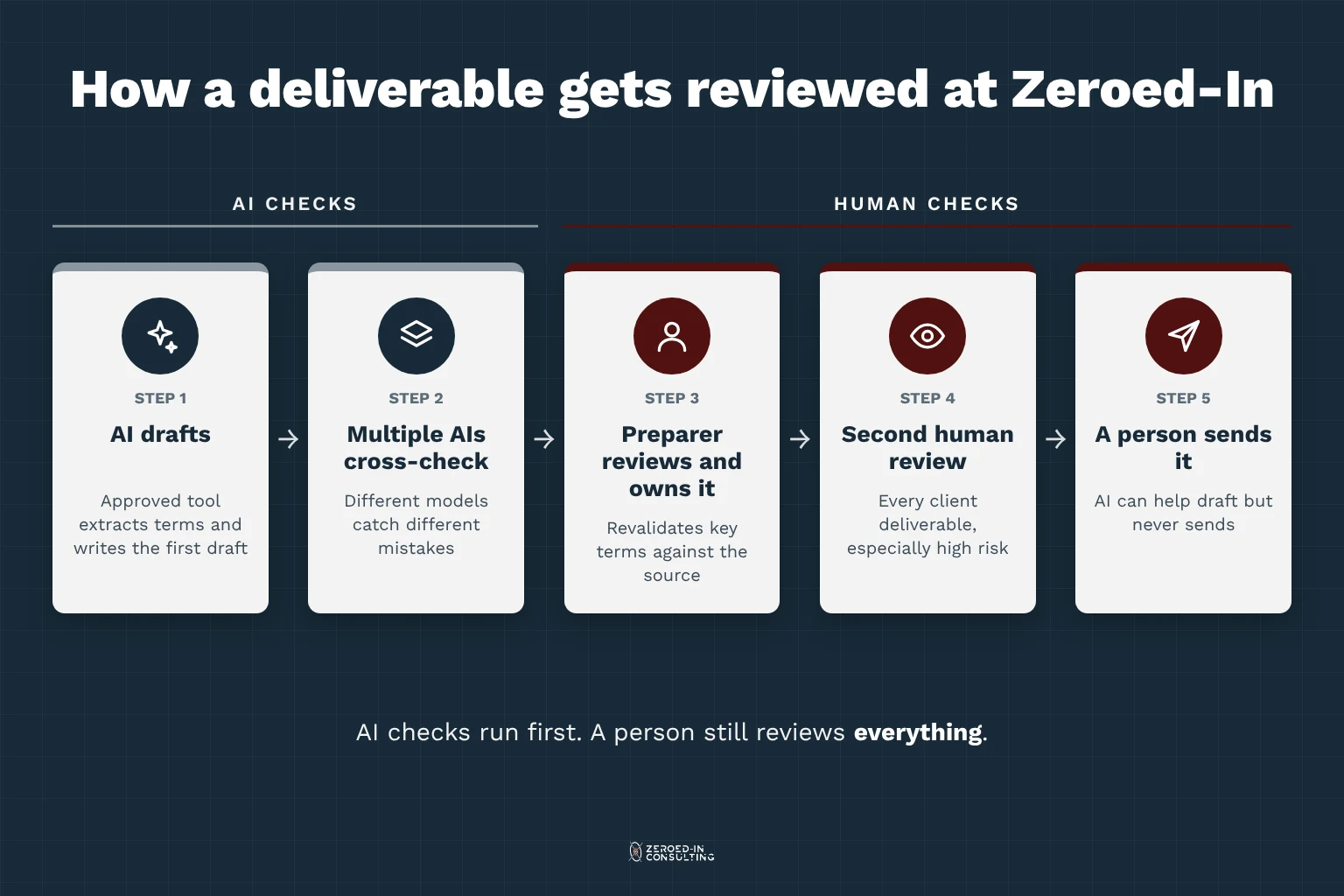
The AI checks run first, and a person still reviews everything after them. As we covered in our AI With Guardrails webinar, a human in the loop is only a control if that person actually checks the work. Automated checks make that review faster. They don't replace it.
Before You Roll Out: A Quick Checklist
If you can check every item below, you're ready to turn the tools on. If you can't, start there.
- 1Approved tool list. Every AI tool your team may use is named, on a business plan, and set so it doesn't train on your data.
- 2Data rules. Everyone knows what data can go into which tool, and that personal accounts are off limits for company data.
- 3Named owners. Whoever uses AI owns what it produces. Your policy says so in one sentence.
- 4Risk tiers. Each workflow is tagged low, medium, high, or off limits, with the review each tier requires.
- 5Hard lines. The few things AI never does on your team are written down and known by everyone.
- 6Audit trail. Source, output, and reviewer sign-off are saved together for anything that touches the financial statements.
- 7Auditor heads-up. Your auditor knows where AI sits in your close before fieldwork, not during it.
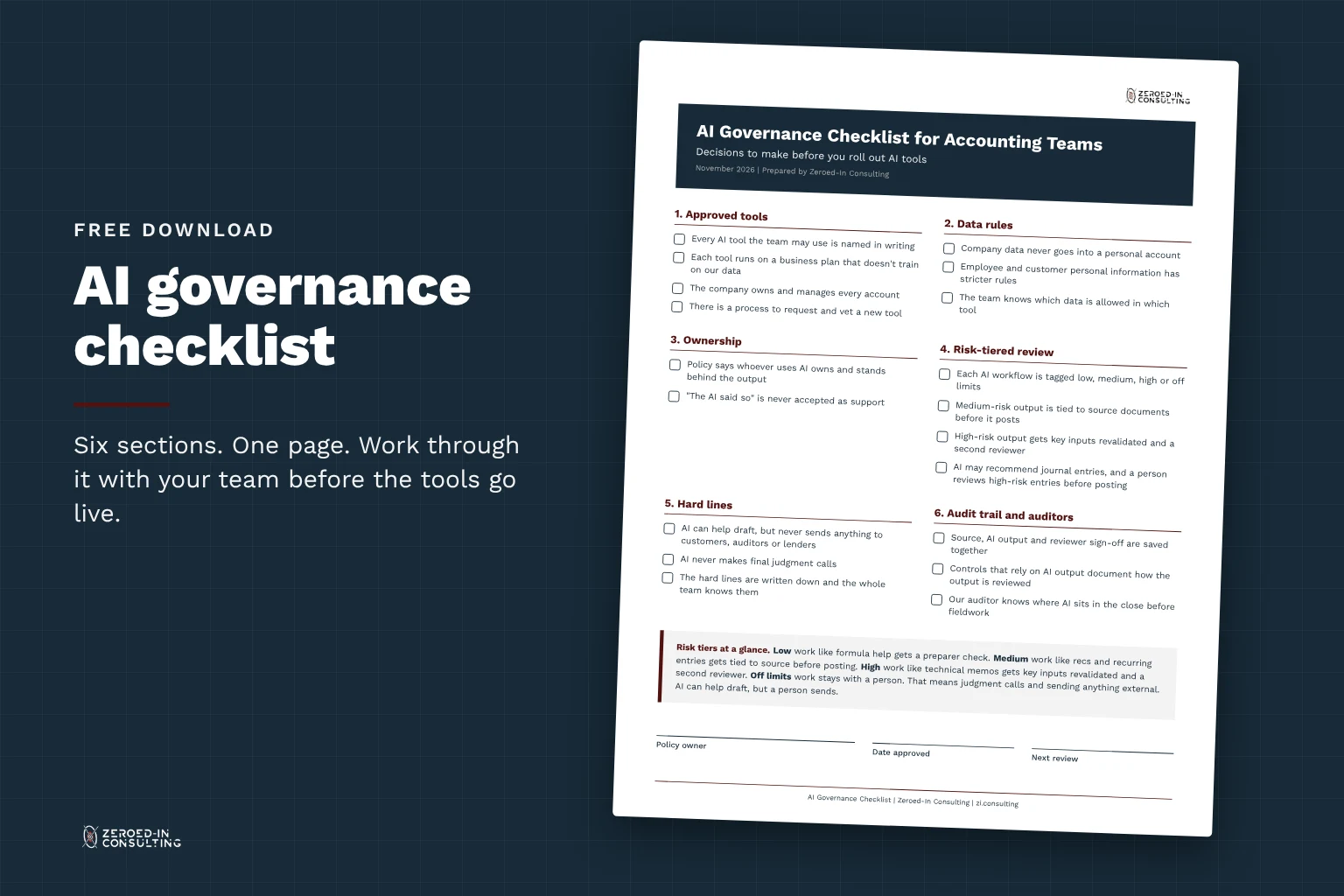
Download the AI governance checklist to work through with your team. Once governance is in place, our post on what AI accounting automation actually does well covers which workflows to start with.
Frequently Asked Questions About AI Governance for Accounting Teams
Yes, but it can be one page. A five-person team still has to decide which tools are approved, what data can go into them, who owns the output, and what gets a second review. Writing those down takes an afternoon. Cleaning up after someone pastes payroll into a personal chatbot account takes a lot longer.
Yes, on a business or enterprise plan that doesn't train on your data, with access managed by your company. Keep company data out of personal accounts, and be stricter with employee and customer personal information than with general ledger detail.
Expect them to ask where AI touches your close, which controls depend on AI output, and how you know the output was reviewed. Auditors care less about who prepared the first draft than whether a qualified person tied it to support and signed off. Keep the source, the output, and the sign-off together. If an audit is on the horizon, our audit readiness checklist covers the rest of what they'll want to see.
Only for low-risk, recurring entries, and only after months of clean output. Even then, someone should review the posted entries at month-end. Non-routine and high-risk entries always get reviewed before they post.
John Ikosipentarhos
President / Co-Founder, Zeroed-In Consulting
John Ikosipentarhos is a CPA in Orange County, CA, with 10+ years in public and private accounting. Specializing in corporate accounting and finance, he helps companies leverage new technologies and automate workflows to reduce costs. He has a Bachelor’s in Business Administration with an Accounting emphasis from Cal State Fullerton.
This article describes the practices Zeroed-In uses in its own work. It isn't legal, compliance, or IT security advice. AI tools and the expectations around them change quickly, and we update our approach as they do. Talk with your auditors and advisors about what fits your company.
Get the AI Governance Checklist
A one-page checklist that covers every decision in this article, from approved tools to the audit trail. Use it before you turn on your next AI tool. Want help putting it in place? See our AI accounting transformation services or schedule a discovery call.
Download the Checklist
Related Articles
AI Accounting Automation for Accounting Departments: What Actually Works and What Does Not
A CPA firm that runs AI in its own close explains what AI accounting automation does well, where it fails, and how accounting departments should start.
John IkosipentarhosFrom Grunt Work to Higher-Value Work and Why Zeroed-In Is Collaborating with Ramp Stack
Zeroed-In's work with Ramp Stack reflects a deliberate approach to AI. We test new technology in real accounting workflows and adopt it when it creates meaningful client value.
John IkosipentarhosWhat a Series B Finance Team Should Actually Look Like
A practical guide to structuring your startup finance team at Series B — balancing permanent hires with fractional and outsourced expertise.
John Ikosipentarhos